Use this AP Mechanics score calculator to estimate your result from a practice exam. Enter your multiple-choice total and four free-response scores to see a weighted composite and an unofficial score from 1 to 5.
Your practice scores
2027-format practice only: 42 MCQs and four FRQs. Older sets may use different limits; blank means zero.
Target AP score
/42
/10
/12
/10
/8
Start here
How to use your practice scores
Start with a scored practice test or an answer key. Count the multiple-choice questions you answered correctly out of 42. Then enter the rubric points you earned on each of the four free-response tasks. Check the scoring guide for the practice exam you used so each number goes in the right field.
Target
Check your path to a 3, 4, or 5
Choose a target to see the estimated composite gap and how many extra MCQ or FRQ raw points alone could cover it. If one section does not have enough points left, the calculator says so instead of suggesting an impossible path.
Share
Reopen the same practice result
The share link stores these five scores and the target in the page address. It does not require an account. Check your numbers before sharing if you would rather keep your practice result private.
GradeCal converts your MCQ correct count to a contribution out of 50: MCQ ÷ 42 × 50. It adds the four FRQ practice scores, scales that total from 40 raw points to another 50, and adds the two contributions. The /100 total is a weighted practice scale, not the percentage of questions you answered correctly. The displayed composite is rounded to one decimal place; the score estimate uses the unrounded value.
Rubric check
Match your practice guide
The four FRQ boxes use practice-rubric maxima of 10, 12, 10, and 8 points, as shown by current score tools. Confirm these maxima match the scoring guide for your practice exam. If your set uses different maxima, convert it to a comparable 40-point FRQ total before relying on this calculator.
Estimated bands
Understand the Mechanics score cutoff estimate
A calculator needs an assumed conversion from a weighted composite to the 1–5 scale. College Board does not promise one permanent raw-score cutoff for every future Mechanics exam. GradeCal uses planning thresholds: 2 at 25.6/100, 3 at 35.0, 4 at 43.8, and 5 at 57.5. These values follow a public comparison of historical and calculator models; they are not official 2027 cutoffs. Other tools can place a boundary a few points away.
Cushion
Read a close result cautiously
The distance-to-boundary figure shows how far your composite is from the nearest estimated threshold. A small margin is a prompt to practice for more cushion, not a probability of earning that AP score. Even a larger margin cannot guarantee your official result.
Raw-point paths
Turn a target into a next step
The target display shows possible extra correct MCQs if your FRQ score stays fixed, or extra FRQ rubric points if your MCQ count stays fixed. These paths describe this model's estimated threshold; they do not predict what you will earn on test day.
Worked example
From raw points to an estimated score
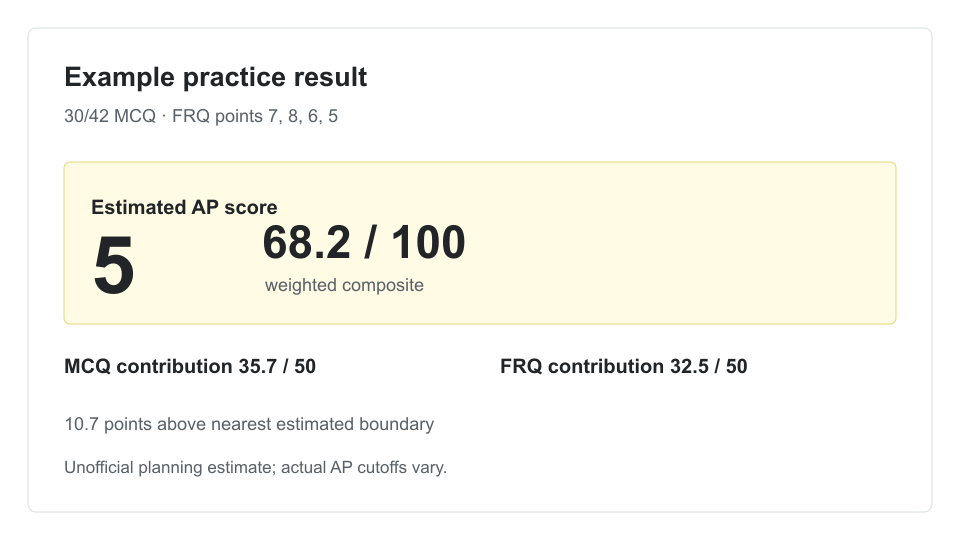
Suppose you answer 30 of 42 multiple-choice questions correctly and earn 7, 8, 6, and 5 points on the four FRQs. That is 26 of 40 FRQ points. MCQ contributes about 35.7 weighted points and FRQ contributes 32.5, for about 68.2/100. Under GradeCal's planning bands, the estimated AP score is 5.
Example: 30 of 42 MCQs and 26 of 40 FRQ points produce a 68.2/100 weighted composite.
If the MCQ contribution is lower than FRQ, review missed multiple-choice topics and timing. If one FRQ task is consistently weak, compare your work with its scoring guideline. The calculator shows the math, but it cannot judge a written response or explain why a rubric point was awarded.
Limits
Distribution context and score limits
Historical AP score distributions from College Board show how students performed in a past administration. They are useful context, but a distribution is not a raw-score conversion table for your practice test. Check the year and subject before comparing figures.
This tool does not retrieve an official score report, apply a college's credit policy, or assign rubric points to FRQ writing. It runs the calculation in your browser from the values you enter. Your official AP score report remains the authority for your exam result.
For assignments and class averages, return to the GradeCal grade calculator. A course grade and an AP exam score are different measurements.
FAQ
AP Mechanics score calculator questions
What percentage do I need for a 5 in AP Physics C: Mechanics?
GradeCal's estimated 5 band begins at 57.5 points on its 100-point weighted scale. That is a planning threshold, not an official percentage for the 2027 exam. Actual conversion can differ by administration.
How are the four Mechanics FRQs scored in this calculator?
Enter rubric points for mathematical routines, translation between representations, experimental design and analysis, and qualitative/quantitative translation. The practice fields total 40 points and are scaled to half the weighted composite. Check your practice exam's own rubric.
Does the AP Physics C: Mechanics curve change each year?
The official score conversion depends on the administration. Public calculators use historical information to estimate bands, and their cutoff estimates can differ. GradeCal shows its assumptions and distance to an estimated boundary.
Can a past score distribution tell me my 2027 score?
No. A distribution reports how many students received each AP score in a past year. It does not establish the future raw points needed for a 3, 4, or 5.
Is this calculator affiliated with College Board?
No. GradeCal is an independent practice-planning tool. The exam structure follows published College Board information, but GradeCal's 1–5 bands are unofficial estimates.