GPA calculator
Estimate a generic U.S.-style course GPA without Seneca policy context.

Seneca Polytechnic planning tool
Estimate a credit-weighted Term GPA, project your Cumulative GPA, and see which designations stay out of the GPA calculation.
Calculations and saved drafts stay in your browser.
Scenario A
Choose a grade or excluded designation, then add its credits.
Enter prior GPA/credits, target GPA, and positive future credits.
Enter valid course results and a failed-course count. This is not an academic-standing decision.
Credit-weighted result
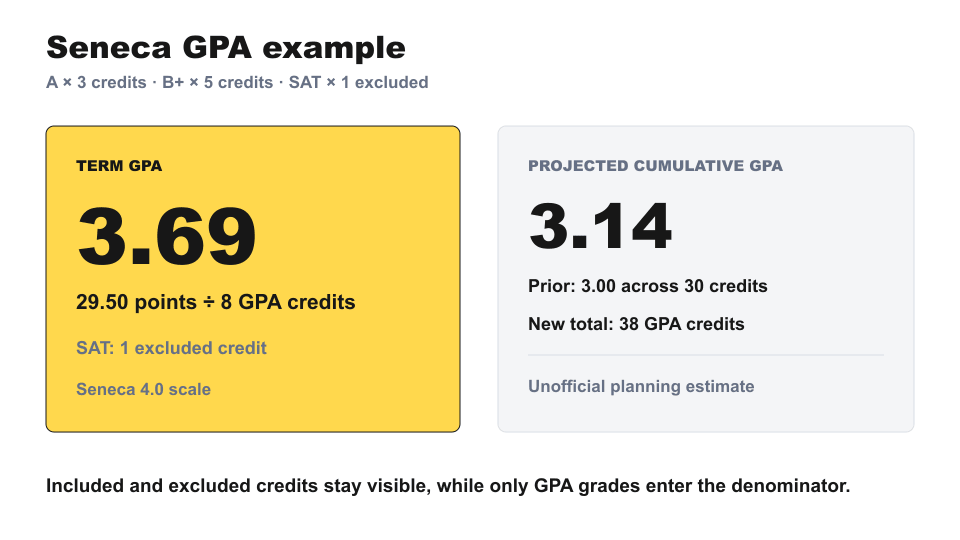
Add each course, choose its grade or designation, and enter its credit value. The Seneca GPA calculator multiplies the grade point by course credits, totals those course points, and divides by the included GPA credits. An A in a three-credit course plus a B+ in a five-credit course produces 29.50 points across eight GPA credits, or a Term GPA of 3.69.
Course names are optional. Add up to 20 rows, remove one beside its name, use the worked example, or reset the plan. The primary result stays the Term GPA, while total points, included credits, and excluded credits make the arithmetic auditable.
Cumulative projection
Enter your current Cumulative GPA and completed GPA credits. The Seneca GPA calculator converts that prior average back to points, adds valid points from this term, and divides by the combined GPA credits. A 3.00 across 30 credits plus the example term projects to 3.14 across 38 credits.
This output is labelled Projected cumulative GPA. It is not a Program GPA, Graduating GPA, or transcript replacement. Those measures can apply additional rules, including treatment of repeated courses, that cannot be reconstructed from one prior aggregate.
Goal planning
Open the target panel and enter a goal plus future GPA credits. The Seneca GPA calculator reports the average required across those credits and marks it already met, reachable, or unreachable. A required average above 4.00 is shown as unreachable instead of being clipped to the top of the scale.
Mathematical reachability is not a promise about a course mix, progression decision, or program rule. Use the number to shape a question for an adviser and confirm important decisions against Seneca's current policies.
One alternative
Scenario B clones the current plan once, so you can change an uncertain course without replacing Scenario A. The Seneca GPA calculator shows the difference in Term GPA and projected cumulative GPA. Both scenarios use the same credit weighting, exclusions, and validation.
The feature is deliberately limited to two scenarios and 20 rows. That keeps the workspace quick and readable on a phone instead of turning a focused estimate into an unbounded spreadsheet.
Published grade values
The published 4.0 scale assigns 4.0 to A+ and A, 3.5 to B+, 3.0 to B, 2.5 to C+, 2.0 to C, 1.5 to D+, 1.0 to D, and 0.0 to F and DNA. Percentage bands belong to published letter-grade ranges; they are not a continuous formula that turns every percentage into a unique point value.
AEG, ATT, AUD, CTC, DNC, EXM, EXC, SAT, TC, UN, WD, and *** do not affect GPA. The Seneca GPA calculator keeps those rows visible and tracks their credits as excluded, but they contribute neither points nor GPA credits. If all rows are excluded, the result is an em dash rather than 0.00 or NaN.
Review the current Seneca Grading Policy and Student Progression and Promotion Policy. Rules can change, and official records remain authoritative.
Reference, not a decision
The standing reference selects the published threshold relevant to a credential type. The current progression policy normally refers to 2.0 for certificate, diploma, advanced diploma, and graduate certificate programs; 2.5 for bachelor programs; and 3.0 for master's programs. Failed-course rules, program requirements, and academic discretion still matter.
The Seneca GPA calculator says whether the Term GPA estimate sits above or below that reference and calls attention to failed courses. It does not determine academic standing. The policy also describes Honours for a Graduating GPA of 3.6–3.9 and High Honours at 4.0, but this calculator does not calculate eligibility or a Graduating GPA.
Local and bounded
The Seneca GPA calculator stores a bounded draft on this device when you choose Save draft; Load draft restores it. Copy summary creates a compact text record. Copy share link creates a versioned URL that restores the course rows, planning values, scenario, and standing reference. Review a URL before sending it because its query string contains the inputs you chose to include.
There is no transcript upload, account, cloud history, OCR, or AI extraction. For a general four-point course tool, use the GPA calculator. For multi-term planning, use the cumulative GPA calculator. Return to the GradeCal grade calculator for weighted course grades and final-score planning.
Example output
The Seneca GPA calculator example keeps its 3.69 Term GPA and 3.14 projected cumulative result distinct while showing the one-credit SAT row as excluded.
FAQ
A 3.0 is the point value assigned to a B on the current published scale. A full GPA is credit-weighted, so it may combine courses above and below B; it is not an exact percentage conversion.
No. Under the current published bands, 70–74% is a B and carries 3.0 points. A C carries 2.0 points and covers a different percentage band.
No. An 80% result falls in the published A range and carries 4.0 points. A 3.0 point value corresponds to B, not A.
Yes. A 93% result falls in the A+ band, and both A+ and A carry 4.0 points. Your overall GPA still depends on all included grades and their credits.
A D has a 1.0 point value and F has 0.0, but passing and progression requirements can vary by course, program, credential, prerequisite, and policy. A point value alone cannot confirm that a requirement has been met.
The current policy describes Honours using a Graduating GPA of 3.6–3.9 and High Honours at 4.0. A 3.5 Term or Cumulative GPA estimate is not the same measure, and eligibility depends on the official academic record.
No. This Seneca GPA calculator is an independent GradeCal planning tool. Your Seneca transcript and official academic decisions remain authoritative.