Calculate a credit-weighted university average, explore NSC levels, or estimate a U.S. 4.0 equivalent. Local results and international references stay clearly separated.
Calculations run in your browser. Your entries are not uploaded.
Quick credits
Paste rows
Paste tab- or comma-separated name, mark, and credits. Preview before applying.
U.S. mapping reference
References can differ. Receiving institutions and evaluators decide which method they accept.
SA weighted average
—Add marks and credits
Indicative U.S. GPA—NC StateScholaro: —
Enter at least one valid module.
Target average
Enter completed results, a target, and remaining credits.
Contribution auditSave, export & share
How to use it
How to use the South African GPA calculator
Choose University for module marks and credits, NSC for achievement levels, or Reverse to look up the South African percentage band associated with a U.S. GPA or listed letter-grade reference. In University mode, add each module, enter its final percentage and credit value, then choose the active study period or cumulative result. The calculator updates as you type.
Your primary result is the South African credit-weighted percentage. The separate U.S. result is only an indicative conversion based on the mapping source you select. Switch between the NC State and Scholaro references to see how the same marks may be interpreted differently.
If your rows already live in a spreadsheet, open Paste rows, paste tab- or comma-separated values, preview them, and apply only the valid rows. You can also save the calculation in this browser, create a bounded share link, copy a summary, download CSV data, print the result, or make a square result card.
University marks
How a South African university average is calculated
Universities commonly calculate an overall average by weighting each final module mark by its credit value. The basic method is:
weighted average = sum(module mark × module credits) ÷ total included credits
A worked credit-weighted example
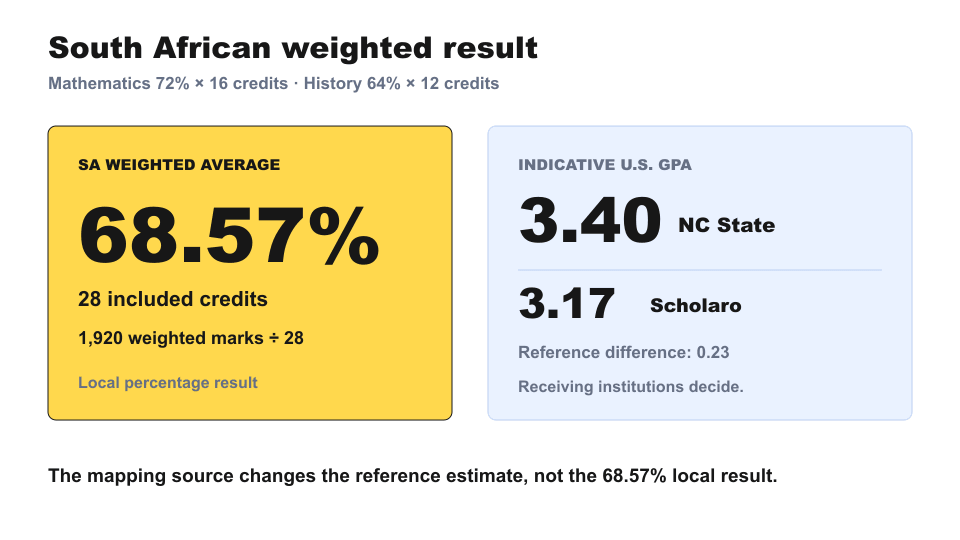
Suppose Mathematics has a mark of 72% and 16 credits, while History has a mark of 64% and 12 credits. The weighted total is (72 × 16) + (64 × 12) = 1,920. Divide that by 28 credits and the South African weighted average is 68.57%.
This South African GPA calculator retains full calculation precision and displays results to two decimal places. Blank or invalid rows are excluded, and row messages explain what needs attention. The contribution view shows how each valid module affects the total.
Check the classification policy
The exact classification attached to a percentage can vary by institution, faculty, qualification, and academic year. Any descriptive label shown here is a general reference, not a statement of your university's official award or progression rules. Check your handbook or transcript guidance when the classification matters.
The weighted formula follows the same basic credit approach explained by the University of Pretoria's module-credit GPA guidance. Use it as a general reference, then follow your institution's published policy when it differs.
Separate results
South African percentage versus a U.S. 4.0 GPA
In South Africa, a student may informally say “GPA” while referring to a percentage-based weighted average. A receiving institution abroad may instead request a value on a 4.0 scale. Those outputs are not interchangeable.
The South African GPA calculator avoids that ambiguity by keeping the local percentage and international estimate in separate result cards. The U.S. estimate converts each included mark with the selected reference table, weights those points by credits, and divides by the same total credits. It does not simply turn the final percentage into one number.
Why the source changes the result
With the worked example, the local result remains 68.57%. The NC State reference produces an indicative 3.40, while the Scholaro reference produces about 3.17. That difference is useful information: there is no single universal South African GPA scale for every international application.
In this South African GPA calculator, changing the source changes only the labelled U.S. reference result; it never rewrites your local weighted percentage. Use the comparison to understand sensitivity, not to choose whichever number looks best.
A university, scholarship provider, credential evaluator, or employer may use its own policy, request the original percentage transcript, or calculate an equivalent internally. Only the receiving organisation can confirm which conversion it accepts.
School results
NSC achievement levels are separate from university marks
NSC results use the Department of Basic Education's seven achievement levels. Level 7 represents 80–100%, level 6 represents 70–79%, and the bands continue down to level 1 for 0–29%. In NSC mode, select each subject's level and optionally assign credits or equal weight.
The local NSC level and description remain the main result. A U.S. letter grade or 4.0 value is shown only as a reference estimate. Do not enter an NSC achievement level as if it were a university module mark: the modes describe different stages and contexts. The South African GPA calculator keeps NSC rows out of university-period totals.
Open the target planner after entering your completed modules. Add the percentage you want and the credits you still expect to take. The tool calculates the weighted average required across those remaining credits.
For example, if your completed average is 68.57% across 28 credits and you have 72 credits remaining, reaching a 75% overall target requires an average of 77.50% in the remaining work. A requirement above 100% is marked unreachable under the supplied assumptions. The planner handles one clear target at a time; it does not predict individual future module marks or admissions outcomes.
Useful checks
When this calculator is useful
Use the South African GPA calculator online when you want to check a semester, combine multiple study periods, audit the contribution of each module, or prepare a transparent estimate for an international form. Period tabs keep terms separate while preserving a cumulative view. Reverse lookup can show the South African band associated with a number such as 3.5 under the selected reference.
If you are learning how to calculate GPA in university South Africa, start with the weighted local percentage and verify that every module has the correct credits. Treat the 4.0 estimate as an explanatory comparison, not a replacement transcript value.
Privacy and limits
Supported inputs, privacy, and limits
Enter percentage marks from 0 to 100, positive credit values, or NSC levels from 1 to 7, within the displayed period and row limits. Paste plain tab- or comma-separated text for preview; transcript files are not uploaded or read. Your calculations, saved data, exports, and image generation stay in your browser.
You cannot upload a transcript or use OCR, AI extraction, email delivery, accounts, cloud history, paid reports, or institution-specific certification here. Treat every result as an educational estimate, not an official credential evaluation or a guarantee of admission, funding, credit transfer, or classification. Share links can contain the calculation data you choose to encode, so review a link before sending it.
Example output
One local result, two reference mappings
The example keeps the 68.57% local weighted average distinct from the 3.40 NC State and 3.17 Scholaro reference estimates.
The source selector changes the indicative U.S. value without changing the South African weighted percentage.
Related calculators
Choose a calculator that matches the grading system
Review the separate, unofficial UAC admissions-method arithmetic.
FAQ
South African GPA questions
Does South Africa use GPA or percentages?
South African schools and universities commonly report percentage marks, achievement levels, or institution-specific classifications rather than one universal national 4.0 GPA. Some people use GPA informally for a weighted university average, while international applications may ask for a U.S.-style value. This page keeps those meanings separate.
How do I calculate GPA in university South Africa?
Multiply each final module mark by its credits, add those weighted marks, and divide by the total included credits. For equal-credit modules, a simple average gives the same result. Check whether your institution excludes, repeats, caps, or treats particular modules differently before using a general calculation for an official purpose.
What is a 4.0 GPA in South Africa?
There is no universal one-to-one answer. Both references implemented here map 75% and above to 4.0, but they differ at lower bands, especially 70–74%. A receiving institution may use another method or assess the original transcript directly.
What does a 3.7 GPA mean in South Africa?
A 3.7 value cannot be converted reliably without naming the reference and context. Reverse mode shows a source-dependent percentage band instead of pretending there is an exact percentage. Use that band for orientation only and follow the receiving organisation's published rules.
Is a 3.5 GPA good in South Africa?
On a U.S. scale, 3.5 is generally a strong result, but a South African equivalent still depends on the mapping. Under the NC State reference used here, reverse lookup places 3.5 in the 60–69% source band. That is a broad reference, not a universal local classification or admissions decision.
Should I use NSC levels or university mode?
Use NSC mode for school subjects reported with achievement levels 1–7. Use University mode for tertiary modules reported as percentages with credits. Keeping the inputs separate avoids applying a school-level descriptor to university coursework.
Do module credits affect the result?
Yes. A higher-credit module contributes more to a weighted average and converted estimate. If every module has the same credit value, equal weighting is equivalent. The contribution audit shows which rows have the greatest effect.
Is this result accepted by universities or credential evaluators?
No acceptance is guaranteed. The calculation is an educational estimate based on your inputs and named public references. Submit official records and use the method required by the organisation reviewing them.